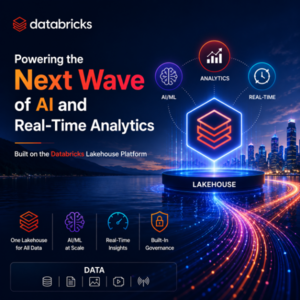
Over the years, organizations were forced to manage two distinct systems, one with a structured reporting system, a data warehouse, and the other with raw unstructured data, a data lake. The outcome? Duplicated infrastructure, inconsistent data, and slow decision making. The Lakehouse model was designed to solve exactly that. It’s data lake reliability and data warehouse flexibility, together in one platform.
The demand for real-time AI has further accelerated the shift. Businesses don’t want the answer from last night’s batch job anymore. Databricks is at the heart of this change. It delivers a unified spot within teams to design data, model training, execute analytics, and scale AI.
What Is the Databricks Lakehouse Platform?
Lakehouse Architecture Definition
A Lakehouse is a single data architecture of both data storage and analytics. It stores raw data in open formats such as Delta Lake and imposes a structure over the top, so that you can run SQL queries and machine learning workloads off of the same source.
Core Components of Databricks Lakehouse
- Data Engineering: To create and manage trusted data pipelines, use Delta Live Tables to ingest, transform, and move data.
- Data Science & Machine Learning: Conduct experiments, handle and deploy models using software such as MLflow and AutoML.
- Data Warehousing: SQL analytics on huge data volumes in real-time with Databricks SQL and the Photon engine.
- Streaming and Real-time analytics: Process live data in real-time as it flows through Apache Spark Structured streaming.
How Databricks enables AI and Machine Learning
- ML Lifecycle Management End-to-End
Databricks assist in the full-life cycle of machine learning, including data preparation or model deployment. Teams don’t need to cobble together five different tools. Everything lives on a platform.
- Generative AI Tools and MLflow Integration
MLflow is an open-source experiment tracking, metrics recording, and model versions saving platform. It is integrated into Databricks. The model runs can be compared by teams, the results can be reproduced, and the best model can be pushed to production all within the same interface.
- Feature Engineering with Feature Store
With Databricks Feature Store, teams can build reusable feature sets to train models. Instead of each team computing the same features, they share one source. This ensures consistency of the model between training and serving environments and avoids duplication.
- Scalable Model Training and Deployment
Databricks employ distributed computing for large-scale model training. Once a model is ready, it can be deployed as a REST API endpoint that applications can call in real time.
Role of Databricks in Generative AI and LLMOps
What is LLMOps?
LLMOps (Large Language Model Operations) is the practice of managing the entire lifecycle of large language models including training, fine-tuning, deployment, and monitoring. This is the ML engineering layer for foundation models.
Databricks Mosaic AI & Foundation Models
Mosaic AI is a suite of Databricks for building and deploying AI. It provides training foundation model infrastructure to train new models, fine-tune existing models, and serve them at scale. It is through open-sources models that teams can customize the models to fit their data.
Large Language Models: Fine-Tuning and Deployment
A business can take an open-source language model and fine tune it on its own internal documents. Databricks handle the compute, tracks the training runs, and serves the final model via an API without any infrastructure management from the team.
Data Governance and Security for AI Workloads
Databricks’ Unity Catalog provides centralized governance for all your data and AI assets. It keeps a record of who accessed what data, when and why. This is important for regulated industries that require audit trails of AI model inputs and outputs.
Benefits of Using Databricks Lakehouse Platform
- Unified Data + AI Platform
A single platform to ingest, transform, analyze, and train AI models. Teams don’t always switch between tools.
- Fewer Data Silos
With a shared Lakehouse, all teams, data engineers, analysts and data scientists work off the same data. There’s no more ‘which version of the data is correct?’ Discussion.
- Accelerated Time to Insights
The raw data is transported automatically in pipelines to queryable tables, saving days to hours, or even minutes, to actionable insight.
- Cost effective and scalable
Databricks run on cloud infrastructure. Teams pay for the compute they use. Clusters handle heavy workloads and scale down when idle.
- Open Ecosystem and Interoperability
Databricks is an open format platform (Delta Lake and Apache Spark). The data is not confined within a proprietary data format. Any other tools can access it and export it freely.
Industry Use Cases in 2026
Healthcare: Predictive Diagnostics
Business Scenario: Hospital system uses Databricks to unite the history of the patient, the results of the lab and the images. The ML model can be used to predict high-risk patients prior to discharge, thereby giving clinical teams time to intervene.
Finance: Fraud Detection and Risk Analytics
Business Scenario: A lending company uses Databricks to run credit risk models on incoming loan applications. Suspicious patterns automatically create queues for review, not manually monitored.
Production: Predictive maintenance
Business Scenario: The factory links its machine sensors to a pipeline within Databricks. The model learns the normal operating range and can send an alert before a piece of equipment breaks down thereby minimizing unexpected downtime.
Telecommunications: Optimizing Networks
Business Scenario: The telecom provider is tracking real-time network traffic patterns. If it finds congestion in a region, the system automatically re-routes bandwidth with model-driven decisions.
Databricks vs. Competitors
| Feature | Databricks | Snowflake | Google BigQuery | AWS Redshift |
| Architecture | Lakehouse (open) | Cloud data warehouse | Serverless data warehouse | Cloud data warehouse |
| ML/AI Native | Yes (built-in MLflow, Mosaic AI) | Limited | Limited | Limited |
| Streaming Support | Strong (Spark Streaming) | Limited | Moderate | Limited |
| Open Formats | Delta Lake (open) | Proprietary | Proprietary | Proprietary |
| LLMOps Support | Yes (Mosaic AI) | No | Partial | No |
| Governance | Unity Catalog (unified) | Snowflake Horizon | Google Dataplex | AWS Glue |
| Best For | Unified AI + analytics | SQL-heavy analytics | GCP-native analytics | AWS-native workloads |
“Databricks is unique because it does both data engineering and AI in one place.” Analytics is where the competitors do well. For serious ML work, you need external tools. Databricks is the most complete tool for teams needing to move from raw data to deployed AI models. And with the right Databricks consulting services, you can achieve great results.
Future Trends: What’s Next for the Databricks Lakehouse
- Growth of AI-Native Data Platforms
AI will be more and more embedded directly into the data layer. The automatic detection of anomalies, intelligent repair of pipelines, and AI-assisted query writing will turn into regular functions.
- Emergence of Real-Time Decision Intelligence
Businesses will increasingly want decisions, not dashboards. The next wave of AI systems will act on data autonomously, within defined guardrails, without waiting for human review.
- Use of Open Data Standards Growing
Vendor lock-in is increasingly a concern, so organizations are focused on open formats. Delta Lake and Apache Iceberg are picking up momentum. Platforms supporting these formats will have an edge.
- Evolution of Serverless Data Infrastructures
Serverless compute is the future of Databricks Lakehouse. This will lower the operational overhead and make data platforms more accessible to smaller engineering teams.”
Why Databricks Is Key to the Future of Data and AI
If your organization is serious about using data to drive decisions and using AI to automate those decisions, you need a platform built for both.” Databricks is the platform for you. It closes the gap between your data team and your AI team with shared infrastructure, shared data, and shared tools. That is not a small matter. That’s the difference between a pilot and a production-grade AI system.
The Lakehouse model isn’t a trend. It is quickly becoming the standard architecture for organizations that need speed, scale, and reliability from their data. As AI becomes more central to how you run your business, the platform that manages your data will dictate how fast you can move. That moment is what Databricks is built for.
FAQs
What does Databricks Lakehouse do?
It serves to store, process, analyze, and construct AI on top of large datasets in a single unified platform.
Will Databricks work with real-time analytics?
Yes. It supports streaming pipelines and the photon engine for low latency query performance on live data.
What Databricks can offer to the development of AI?
It provides end-to-end ML tools like MLflow to track experiments, Feature Store to store reusable features, and Mosaic AI to train and deploy large language models.
What is the difference between Databricks and Data warehouse?
A data warehouse is where you store organized data, so you can implement SQL analytics to it. Databricks supports unstructured data, machine learning and streaming, and is a more comprehensive platform to support analytics and AI.

Post submitted by: Teena
Country : United States